Case Study: Removal of Metformin to Below PNEC Levels
Successful removal of Metformin from pharmaceutical wastewater, reducing concentrations to levels below the Predicted No Effect Concentration (PNEC).
The client was involved in the manufacture of metformin, a persistent active pharmaceutical ingredient (API), which could not be treated at the site’s existing wastewater treatment plant. As such, these streams were transported off-site for incineration via a third party.
The purpose of this project was to find a solution to treat the wastewater streams containing APIs on-site. It focused particularly on a stream contaminated with metformin, and guanylurea, among other compounds.
Arvia was approached by one of the world’s largest pharmaceutical companies whose transition to science-based targets around waste management was driving the requirement to analyse waste in more detail.
Arvia’s patented advanced electrochemical oxidation technology offered a unique, cost-effective treatment option for hazardous organics, colour and micropollutants in raw water, process water and wastewater streams.
Treated water flows could either be re-used or safely discharged, offering an alternative to other tertiary water treatment solutions available on the market.
Irais Baizabal
Wastewater consultant
Schedule a call with one of our wastewater treatment consultants at your convenience. Or you can send us an enquiry.
The objective of this project was to identify a viable on-site treatment solution for API-contaminated wastewater streams. A particular focus was placed on a clean-in-place (CIP) wastewater stream generated during equipment and storage tank washing operations, which contained metformin, guanylurea, and other compounds.
A successful treatment solution had to reduce metformin and guanylurea concentrations below their respective Predicted No Effect Concentration (PNEC) thresholds of 1 ppm and 0.16 ppm.
The collaboration between the client and Arvia aimed to evaluate Arvia’s Nyex™ water treatment technology as a potential solution for treating API-contaminated effluent. Nyex™ systems utilised electrochemical oxidation, a highly effective technology for the destruction of a broad range of pharmaceutical compounds.
This approach offered several advantages aligned with the project objectives, including complete contaminant destruction without generating secondary liquid or solid waste streams, and operation without the use of hazardous chemicals.
Pharmaceutical company, US
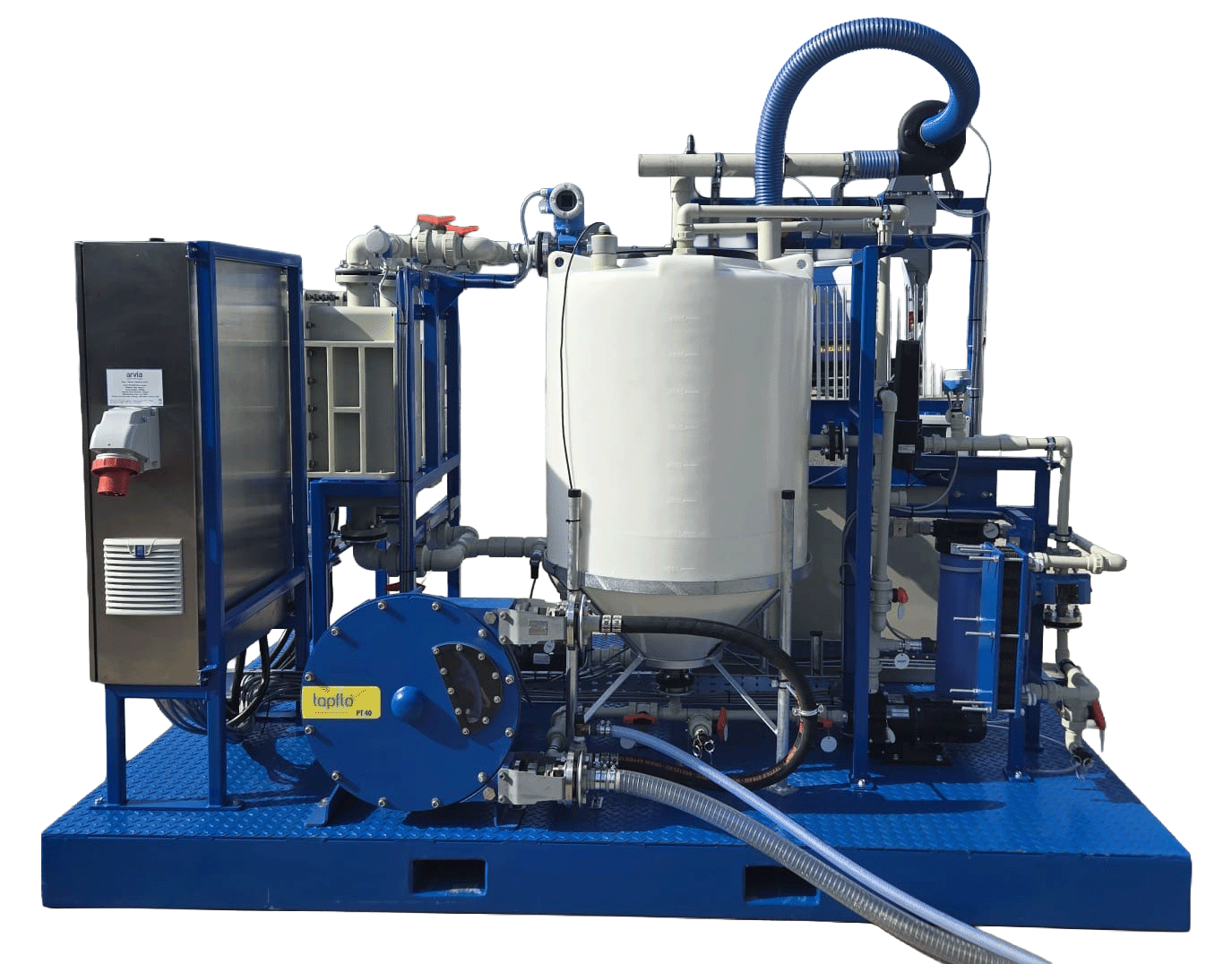
A successful treatability study demonstrated that Arvia’s Ellenox™ Nyex.5 electrochemical oxidation technology could achieve the required performance targets. Based on these results, a pilot trial was conducted on site.
The pilot validated Ellenox™ Nyex.5 as an effective, reliable, and scalable solution for on site treatment of the client’s wastewater. The system met the project objectives, demonstrating strong operational robustness, and providing our client with a viable pathway to reduce off site waste handling and advance its sustainability goals.
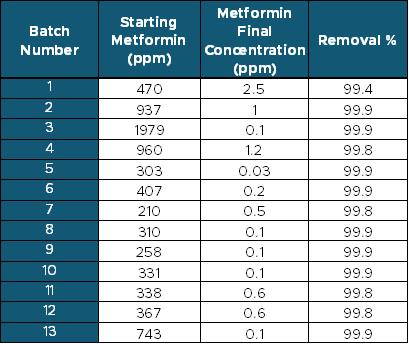
Across thirteen pilot experiments, Ellenox™ Nyex.5 consistently destroyed metformin, guanylurea, and background organic load (TOC) despite significant variability in inlet concentrations. Metformin levels ranged from 210 to 1979 ppm, and guanylurea from typical values of 1.5–13 ppm up to an outlier of 538 ppm. In all representative trials, the system achieved the required PNEC limits for metformin (1 ppm) and guanylurea (0.16 ppm). TOC removal exceeded 98%, reaching values around 10 ppm.
Tell us what organic compounds you need to remove from your water and our consultants will give their recommended approach which might involve:
03.3.2023
Case study shows how our Nyex Ellenox system achieved over 99% removal rate of Triton X 100 (4-tert-OPnEO) from pharmaceutical wastewater.
03.3.2023
A pharma company asked us to help them stop the spread of AMR by removing APIs and COD from wash water.
03.3.2023
"Arvia's technology is innovative and has been proven to solve our waste issue."
Life sciences
We remove APIs and hard-to-treat micropollutants from wastewater for pharma, CDMOs, animal health, biotech and biopharma sectors.
Speciality Chemicals
We help specialty chemical companies clean their process water, removing active ingredients, biocides, recalcitrant COD and micropollutants.
Agrochemicals
Our industrial wastewater treatment process is very effective in removing organic chemicals such as pesticides, herbicides and insecticides.

Manufacturing
We provide industrial wastewater treatment solutions removing biocides and other micropollutants in wash water and blowdown water.
Aquaculture
Our aquaculture wastewater treatment removes pesticides used to treat sea lice, as well as medicines and off-flavours found in RAS facilities.